Saturday, April 7, 2012

Surprises: Healthy Banana Nut Muffins

My dad had a heart attack last weekend.  He quickly realized that his body was not functioning properly, called my mom who was next door, and within seconds she had him in the car on the way to the hospital.   I'm sure she covered the 5 miles in record speed.   Luckily, our local hospital, which primarily caters to the white, upper middle class residents of our town, are experts in heart care.  They recognized and treated him right away, so any damage was limited.  But, my dad, a fit looking 65 year old, who has been on a low cholesterol diet for 30 years and cholesterol medication for 20, has four severely blocked arteries.  He will need additional procedures to alleviate the blockage.

I was in California when it happened, and only made it back to Chicago on Wednesday.  My dad had just been discharged from the hospital.  He looked great and sounded like his normal self, although a bit weary.  He is on house arrest for at least a month and has already started to get bored.  Luckily, he has our two dogs to keep him company.  They are quite a handful.

I've been cooking my parents foods that are low fat and cholesterol-free since I got back (which has only been two nights, so it hasn't been a challenge).  I decided to restart this blog so that when I go back to my apartment this weekend, I can easily share recipes with them and with my brother and sister, who might also want to incorporate more of this style of cooking into their repertoire.


I came up with these dairy and oil-free muffins after reading through a fair number of recipes.  Before my dad's heart attack I had already begun experimenting with using applesauce and yogurt in place of butter in baking recipes with quite a bit of success, so I wasn't afraid to try cutting out all milk derivatives.  Nonetheless, I was quite surprised at how well these turned out.  They will never replace a rich, cakey muffin, but they are dense, nutty and moist.  Perfect for a wholesome breakfast.

Surprisingly Good Healthy Banana Nut Muffins

INGREDIENTS

Dry Ingredients
1c whole wheat flour
1c wheat bran
2tsp baking powder
1/2tsp baking soda
1/2tsp cinnamon
1/4tsp nutmeg
1/2tsp salt
Wet Ingredients
1/2c applesauce*
2egg whites
2large very very very ripe bananas
1/4c honey
1/2cup chopped walnuts
Turbinado sugar for garnish
Add Ons
1/2c dried or frozen blue berries
1/2c small chocolate chips
1/2c chopped fresh/frozen cranberries
*Make sure its unsweetened

INSTRUCTIONS

1.Preheat oven to 350 and either grease muffin pan or line muffin pan with baking cups.
2.Mix all dry ingredients together in a large bowl. Set aside.
3.In a small bowl, mash bananas until all large chunks are gone. Add the remainder of the wet ingredients and stir until mixed.
4.Pour the wet ingredients into the dry ingredients and stir until just combined. Stir in the walnuts and any other add-ons, such as frozen or dried blueberries or dark chocolate chips.
5.Scoop into muffin pan, just under filling the cups. They will rise only a little bit. Sprinkle with remaining walnuts and garnish each with a pinch of turbinado sugar.
6.Bake for 25 minutes or until a tooth pick inserted in the center of the muffins comes out clean. They will be a fairly deep brown color, but not burned. Cool for a few minutes, then transfer to a wire rack to cool further.

They will keep well for several days in an air tight container or a few months if frozen. Refresh by sticking them in the toaster oven for a few minutes.

Sunday, April 24, 2011

A Return to Blogging?

Perhaps.

On Friday I handed a draft of my thesis to the members of my committee.   Berkeley does not have a thesis defense, so all that stands between me and a PhD are three signatures.  Hallelujah!  I am decidedly sick of my thesis topic and ready to move onto the Next Big Thing, although I'm not sure I'm ready to leave Berkeley.  I want to write about what has happened in the last nine months and what I plan to do in the future, but I don't want to get carried away on my first post-thesis (draft) post.  That's how injuries happen.  So, in the following, all you'll get is a recipe.  But it was yummy, and it gave me immense pleasure to be cooking, guilt-free, in the kitchen again.


Warm Spring Root Vegetable and Lentil Salad over Braised Greens


Kyle also distributed a draft of his thesis on Friday, so in celebration on Saturday night, I cooked for the first time in weeks.  For much of the past month our diet consisted of burritos, pizza and Indian take-out, so I was in the mood for a vegetable-heavy healthy meal.  I wanted something that tasted healthy.  A trip to my favorite grocery store left me with several bunches of beets, a couple bunches of beautiful multi-colored young carrots and a mysterious green that looked like a white kale, but that doesn't seem to exist.  I was a little uncertain what to do with it all, but I found some lentils in the freezer and the following dish was born.  The weather here in Berkeley has been unusually gloomy and I think this salad captures the it's-raining-and-i'm-still-wearing-sweaters part of spring.


For the salad:

2 cups of cooked french lentils*
2 bunches of beets or 4 large ones
2 bunches of fresh carrots, sliced lengthwise into spears
1/2 cup of pepitas

1/3 cup of balsamic vinaigrette
(mix 2-3 parts oil to 1 part vinegar and thrown in a bit of nice mustard. adding a pinch of herb de provence is a nice touch)

For the greens:

3 cloves of garlic, sliced
1/3 cup of white wine
1/3 cup of water
1 bunch of kale, or collards,  or mustard greens,  or chard + any good greens from the beets

olive oil
salt and pepper


Turn the oven on to 350 F.  Wrap the beets in foil.  Roast them until tender, which can range from 30 min to a half an hour.  While the beets are cooking, throw the pepitas in a roasting pan and put them in the oven on a different rack.  Roast until nicely browned, approximately 5 min, although it will depend on how hot the oven is at that point.  In the meantime, slice the the carrots into thin strips, toss with olive oil and salt.  When the pepitas are done, put them on a plate and transfer the carrots into the roasting pan.  Put the pan back in the oven and cook the carrots until browned, 10-20 min depending on the size.  I had two bunches of pretty multi-colored small carrots which did not take long.   While the carrots are cooking, heat the olive oil in a sauce pan over medium heat, add the garlic and the stems of the greens.  Cook until the stems are soft, then add the leaves, wine, water and a few pinches of salt.  Stir then cover and cook for 10 min or until the greens are tender.   Once the beets are done, peel them and cut into bite sized pieces.

Mix the beets, carrots, pepitas and vinaigrette together.  You can put them into a covered oven safe bowl and put them in the still warm oven to warm through until you are ready to serve.  Heating them up will sweeten the balsamic vinegar, which is a nice touch.  Serve over the greens.  Some feta or goat cheese would probably be a good addition as well.

* Lentils freeze well, so I often make a whole pot of them and then put them into the freezer in small containers for later use.

Monday, August 23, 2010

August Tour

I'm writing this post from the comfort of a Canadian railroad car, beginning the last leg of my August tour.  In mid-July I was asked by the collaboration to give a talk in Boston on August 11th and present a poster in Toronto on August 22nd.  It seemed silly to go back to Geneva in between the two conferences, so I threw in visits to Berkeley, Naperville and Ann Arbor in between them.  It's been exhausting and I'm happy to say that I will be in Toronto for nearly a week.  I may even get to unpack my suitcase.

Getting asked by the collaboration to go to these conferences may sound like a big deal, but, in reality it is quite normal.  In our field collaborations rather than people are asked to give talks, and we use our favorite tool, committees, to divy up the engagements.  Talks are assigned to young people on the job market or to senior people as a reward for their service to the collaboration.  There is a priority list which makes sure that the talks are evenly divided so that no one gets overlooked.  Its a quirk of our system that often the presenter gives talks on analyses he or she has not worked on.  Its a legitimate method because each of us are authors on all of the analyses so we should be able to talk about any of them, but in reality the speaker has to do quite a bit of homework to put together the talk.  Half of my talk at the MIT concerned an analysis I didn't work on; it was useful to learn about it so that I could present the material in a coherent way.

Two days before I left Geneva I made a tomato tarte that was as good as it was simple.  It comes from David Leibovitz's blog, with very minor modifications.  David's recipes are always excellent, and this one is no exception.  I used an assortment of heirloom tomatoes of different colors which had a very pretty effect.  Its a very buttery crust, so you might want to try something a bit healthier, like this one.


Heirloom Tomato Tarte

4 or 5 medium sized heirloom tomatoes, sliced 1/2 inch thick
1/2 a small onion sliced as thinly as possible
A few tablespoons of dijon mustard (I used the unground à l'ancienne style)
plenty of fresh thyme, leaves only
salt and pepper 
olive oil
8 oz goat cheese; it's best to use one with a rind of some sort.  mine was very slightly aged so had a thin rind. 

tart dough:
1 1/2 cups  flour
4 1/2 ounces unsalted butter, chilled, cut into cubes
1/2 teaspoon salt
1 large egg
2-3 tablespoons cold water


First make the tart dough.  Mix the flour and salt in a bowl.  In a food processor, stand mixer or using your hands, mix or pulse the butter into the flour until the mixture has a crumbly texture and there are no large pieces of butter left.

Mix the egg and 2 tablespoons of water in a bowl.  Add to the food processer and pulse until the liquid is  incorporated and the dough holds together.  Add the extra water if needed.

 On a floured surface, roll the dough into a ball.  Roll until it is about 1/4 -1/2 in thick.  You can get it into the tart pan with an ingenious (and probably standard) method that David outlines: you flour the rolling pin and roll the dough up around the pin to transfer it to the pan. 

Press the dough into the pan and dock it with a fork.  Preheat the oven to 425F.  

Smear the bottom of the crust with the mustard.  You can put a nice thick layer on if you like mustard.  Then spread the onion on top, followed by half of the thyme.  

Arrange the tomatoes on top in concentric circles.  Mine didn't overlap, but they probably could without too much trouble.  Arrange the cheese on top and sprinkle with the rest of the thyme.  Add salt and pepper to taste and then drizzle with olive oil.

Bake for 30 minutes or so.  Be careful to check that it doesn't burn--as you can see from the picture below, mine was a bit charred.  Serve hot or warm.  I had leftovers on the plane and they were nearly as good as when it was fresh!


Sunday, August 8, 2010

A winner and loser on the NYTimes

Denis Overbye, number one science writer for the New York Times, has to be one of my least favorite science writers. Well, let's face it, I don't know very many science writers by name, but if I come across an article about the physical sciences in the New York Times and it makes me groan, it was usually written by David Overbye. He got a lot of mileage out of the black hole LHC hysteria, and more recently, propagated unfounded rumors from a known rumor monger blogger of a Fermilab Higgs discovery. He has a penchant for sensationalism, and when he covers topics which delve into the 'mysteries of the universe' he likes to milk them for anything he can get, imagined or not.

He recently published an essay titled, "Rumors in Astrophysics Spread at Light Speed", which discusses the role of rumors in the physical sciences. It starts off pretty badly with an anecdote about an astronomer who said something at a public outreach talk that was misconstrued. Overbye calls this "2 sigma blues" which has nothing to do with the anecdote.  A 2 sigma result means something very precise, statistically, it is certainly not related to poor word choice.  What he really wants to talk about is a rumor that was started about a month ago by a physics-blogger-trouble-maker-rumor-monger, who said there might be a hint of the Higgs at FermiLab. This little rumor flared up all over the internet and generally pissed the FermiLab scientists off because they didn't want to be seen as crying wolf.  Overbye then philosophizes about why he thinks rumors like this get started.  Its certainly not his worst article, but it still makes me groan.  I just wanted to complain for a bit.

On a positive NY Times note, I found an excellent recipe for a provençal style potato and tomato gratin. I was shocked at how well it came out.  I made a few slight modifications, so I rewrote the recipe here.  You should use good tomatoes and good potatoes--preferably not the baked potato type.  I used some fingerlings and some other random variety I found at the market.

Provençal Tomato-Potato Gratin

2 garlic cloves
Olive oil
2.5 pounds tomatoes, sliced 1/2-1/4 inch thick
1.5 Tbsp fresh thyme leaves
Salt and pepper to taste
2 pounds potatoes, sliced about 1/4 inch thick
1 tsp herbs de provence 
.5-1 cup of grated gruyère


1. Preheat the oven to 400 degrees. Cut one of the garlic cloves in half, and rub a 3-quart gratin or baking dish with the cut half. Oil the dish with olive oil. Mince the remaining garlic, along with the one you used to rub the dish and toss them in with the tomatoes. Add the thyme, and season to taste with salt and freshly ground pepper.
2. Make a layer of half the potato slices.  Mine were all different sizes, so it was a bit of a mess, but I tried to make it in more or less one slice thick.   Then season very generously with salt and pepper. I'm not kidding, you really want to salt it.  Sprinkle with half of the herbs de provence.  
3. Layer half the tomatoes over the potatoes.  I had them all overlap a bit.
4. Repeat the layers with the remaining potatoes and tomatoes. Make sure you salt and pepper the second layer of potatoes. Pour any juices left in the tomato bowl over the vegetables.
5. Pour 3/4 cup of hot water onto the vegetables. Bake 45 minutes.  The recipe recommends pressing the potatoes down into the liquid after 30 minutes, I didn't find this necessary. After the 45 min is up, sprinkle on the cheese. Bake another 30 to 45 minutes, until most of the liquid has been absorbed by the potatoes and the gratin is lightly browned. Or really browned, as in my case.  Serve hot or warm.


Sunday, August 1, 2010

How an Analysis Becomes Official

In my last post I alluded to the fact that it is no trivial matter to take an analysis from a bunch of plots that I have made to an official statement of scientific fact put out by the collaboration. The road to approval is so long because in high energy physics, all members of the collaboration publish a result, not individuals. In fact, from outside of the collaboration you have no way of knowing who performed which analysis by reading the documentation. Most other scientists find this arrangement very strange since generally papers are very explicit about the level of involvement each name on the paper had in its production. High energy physicists take the egalitarian view that since our experiments are so large and complex, they cannot function without all of the members, and that the contribution of the person running the pixel detector is no less important that the person who is searching for the Higgs. Therefore, every name (all 3000 of them!) gets put on all papers in alphabetical order. The approval process is designed so that all collaborators can have their say about each analysis, which generally means that any result coming out of a HEP collaboration has gone through much stricter peer review than the average journal article. It also results in a lot of headaches for the person trying to get the analysis approved.


To explain the process, I'm going to employ School House Rock's awesome and educational, "How a a bill becomes a law". Rewatch it if you haven't seen it in a while. It's pretty great.


The Bill in question is my analysis and I play the part of the congresman who proposes it. My advisor is represented by the people who ask for the law, because she came up with the analysis concept. The drafting of the law, i.e. the dirty work of the analysis, kept me at CERN until obscene hours of the night for days on end in May and June. The committee fits best into the role of the Analysis Reviewers and Editorial Board, to which each analysis is assigned. These people look at the analysis in detail and typically ask you good question which drive you back to your computer to investigate, and in the end produce a better paper.

Once the board and reviewers deem the analysis mature enough, the paper (which, in this case, is not destined for a journal, but will be made public) is sent out to the collaboration and they are given a week to comment on it. This stage is equivalent to the Bill going to the House and Senate (imagine we have a single legislative body). At the end of the comment period the analyzer gives a talk about it, which would be equivalent to a floor debate. This part of the process involved me flying to Copenhagen to give a talk at our Collaboration meeting to a room of about 300 people. It was a little intimidating, but also fun because I got to use a nifty nearly invisible microphone that went over my ear and an enormous screen (12 ft tall, maybe?). My talk went smoothly, with no interjections or grumbling when the Physics convenor spoke the magic words, "Does anyone object to this continuing to the next stage?". Some of the analyses were contentious and forced to revise before coming up for a approval again. In most cases I agreed that the analysis wasn't quite ready and felt that the approval procedure had done its job.

Sadly, once ATLAS approves my analysis it does not go to Obama's desk. It instead goes to two of the three heads of management of the experiment: the Publication Committee chair, the Physics convenor and the Spokesperson. The first two read my analysis, and this is where it stalled a bit. I won't go into the details, but it was very confusing and frustrating. However, once those two "sign-off" on the analysis it is ready to go to the public and the long, arduous journey is over! The analysis now has the ATLAS stamp of approval.

I'm going to two conferences this August to present my work (and the work of others). Its quite exciting to know that for almost the first time I'll be showing plots that were made by me!

Tuesday, July 27, 2010

Something To Celebrate

This morning Kyle boarded a plane headed back to Berkeley, his seven week visit having passed entirely too quickly with decidedly too much work and not enough fun.  Despite the stress of collaboration approval deadlines for me, and the pressure to publish for him, it was great to share the CERN experience for a while.  We even managed to have a bit of fun on a trip to Sweden and on some weekend bike rides and hikes.


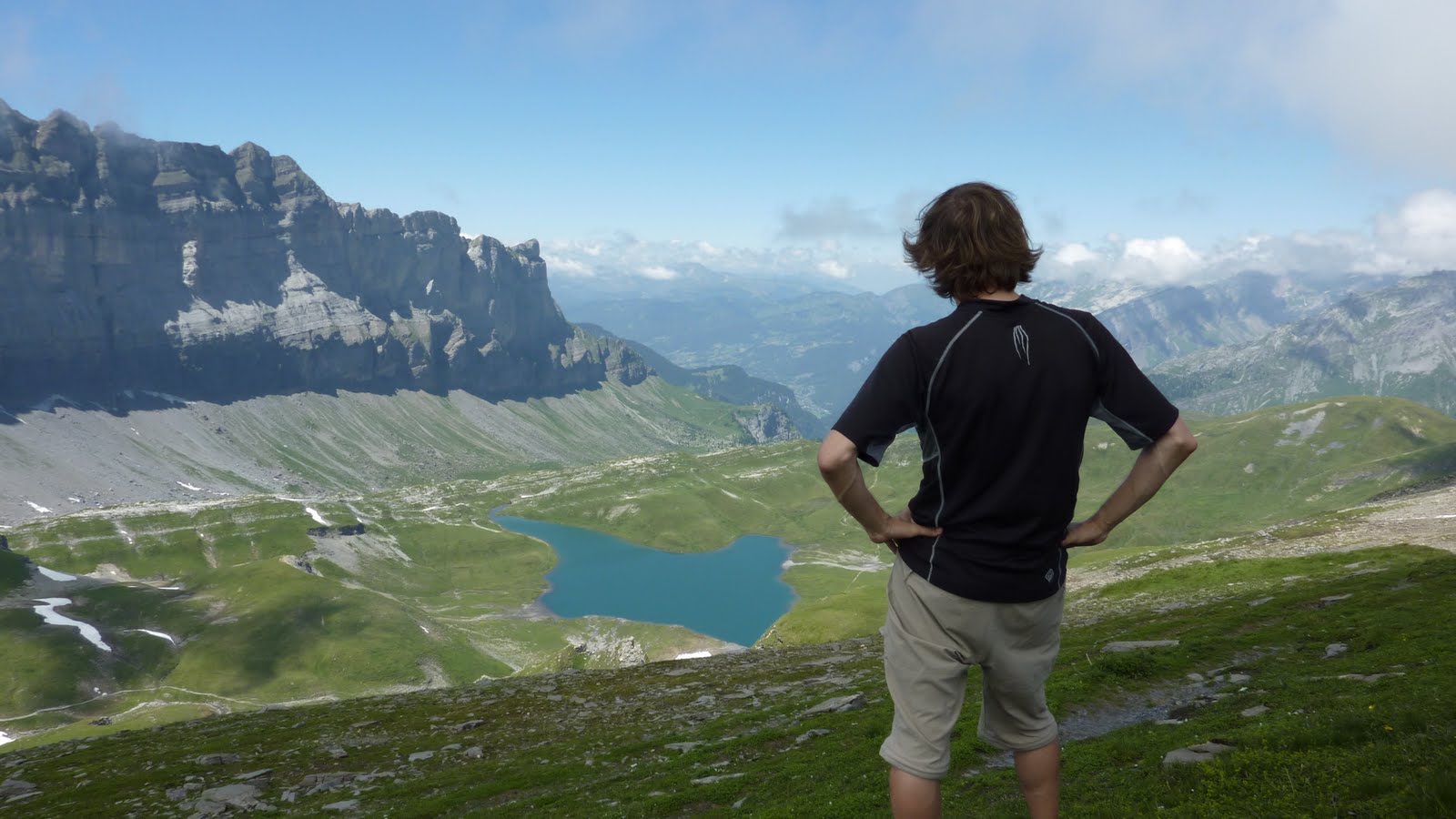
Overlooking Lac d'Anternne

Rather than wallow in loneliness on the evening of his departure, I thought I would finally share my first public physics result (!) and a meal that we had on the evening it became official.

While most theses in high energy physics are quests to understand one-in-a-million type interactions,  my thesis concerns relatively ordinary proton-proton collisions.   In these ho-hum interactions the protons interact a little bit, but not enough to produce the fireworks we are accustomed to seeing in the pretty pictures the experiments put out for PR purposes.

A W boson decaying to electron and neutrino: total propaganda

In the events I'm interested in the protons do not exchange quantum numbers, they merely jostle each other without combining to form new particles.  The jostling, however, does impart enough energy to one or both of the protons so that it disintegrates into many low energy particles.  The characteristic signature of these events is activity near the beams, but not a lot of activity perpendicular to the beams.  In particular I'm selecting events which have activity on only one side of the detector.  This requirement isolates these jostling type events so that we can begin to understand them better.  
A plot of the ratio of the number of events with activity on only one side of the detector to events with activity on either as a function of the ratio of jostling-type interactions.

These events are interesting to understand because they make up a non trivial component of the total proton proton interaction rate, but are hard to model theoretically.  They are also distantly related to what I think is the coolest measurement the LHC can make, which is the subject of another post.  Eventually, once I complete the analysis, I hope theorists can use the my measurement to understand these events better.  


In a latter post I'll go over what it takes for a result to become public (i.e. become collaboration approved), but for now it suffices to say, its nearly as arduous as doing the analysis itself.  When it was all said and done, Kyle and I had a little celebration at home, with a nice rosé de gamay, the summer speciality of this region, and the goat cheese and roasted tomato tart you see below.

Nothing beats roasted tomatoes

It doesn't really qualify as an 'original' recipe, rather it's a riff on this yogurt crust tarte fine at Chocolate & Zucchini.  I made the same crust she specifies, although I didn't have sesame seeds so I couldn't roll those into the crust.  I used goat cheese and milk for the spread and flavored it with chopped parsley, basil, lemon zest, salt and a tiny bit of red pepper.  Tomatoes were roasted the night before so it was relatively easy to put together!

 The next day I made a ghetto pesto by chopping everything by hand and topped the leftover crust with it, roasted mushrooms and the last of the tomatoes. Yum!  


Friday, July 16, 2010

My Return is Imminent

The first phase of my analysis is almost public.  It got caught up in a bit of politicking (what HEP analysis doesn't?) but hopefully within a day or two it will fully approved and I will be able to post some of the plots here!  I'll explain the process by which the experiment endorses an analysis when I post them, but it suffices to say that it is a slow, complicated, painful process.  Now that it is nearly over, I'll have some more time for blogging, which I'm really looking forward to.

I've mostly been cooking pasta when I have the time, but tonight it was so hot I made hummus from a recipe posted by David Lebovitz, which hit the spot!  Mine was rustic, as I have no blender or other electrified means of blending ingredients so I used a potato masher instead.  Still, with a salad and some freshly made (not by me) pita bread, it was a perfect summer dinner.

Tuesday, June 1, 2010

Weekly Update #1, Part 2

Well, I've been at CERN for almost 16 hrs today and most of that time has been spent working....  So here is what would've been my weekly update, except it almost entirely in pictures

Saturday I went on a bike ride through the wine country with some friends

It was Caves Ouvertes, a day when all the wineries opened up for free wine tasting and lots of yummy food.  Like the Russian River Wine Road.
This was the booze train, but the driver had a glass of wine in his hand...only in France...or french speaker switzerland
There are gorgeous tomatoes from Italy right now.
While writing the draft of my note I made a tarte inspired by this recipe.  It was the same except I used fine grain semolina instead of spelt flour, a 1:1 ratio of creme fraiche to broth, mustard greens instead of turnip greens, and I threw in some chopped peruvian olives (like kalamata) for kicks....yum.
I made a cherry tart with the left over dough...think Cheeseboard corn cherry scone in galette form.

I needed good food to fuel my writing!

Monday, May 31, 2010

Trying Something New: Weekly Update #1

It is clear that with advent of data, my time for writing has been reduced to next to nothing.  Most of my creative energies are going into my work, which is fantastic, yet it makes for some boring blogging.  Even worse, I haven't cooked anything particularly interesting in a while, the recipe I posted last time being the only exception.  So, in order to bring some balance to my work driven life and to perhaps inspire me to cook something bloggable again, I am attempting to post an update once a week, hopefully with a little bit of physics, a recipe and maybe something about life here.      

This week I have to have a draft of an internal paper on the first phase of my analysis done by Tuesday evening (Ack!) .  It is the first jump through a series of hoops I have to make it through between now and the conference in July iin which I am hoping to show my results (or have my results shown...which is another quirk of HEP).  The collaboration has to approve the public presentation of any plots, and its a multi stage process to get a community of 3,000 people to agree to do so.  The current strategy, which no one likes or completely understands, involves first writing an internal paper about the analysis which triggers the relevant physics group leaders to assign three to four analysis reviewers to it.  The reviewers give suggestions, over see the analysis and when they are reasonably happy the result is first sent to the physics group for approval and only then is it presented to the collaboration for approval.  Somewhere along the way a paper which is suitable for public consumption is produced.  This process doesn't sound too bad the way I've described it, but it seems to be infinitely more complicated in practice.  My fellow Berkeley grad student Seth has a blog post about one of his experiences with the approval procedure up at USLHC blogs.  It's aptly titled, "Collaborating isn't always easy".

In order to get the draft together I have a lot of work to do in the next 24 hrs, yet I find myself in front of my computer, writing in order to clear my head.  I just got back from CERN, having taken the second to last bus, which left CERN at 11:30, home.  I spent the half an hour long ride toute seule, listening to the Dixie Chicks, watching stop after stop go by empty.  It was rather depressing, yet calming at the same time.  Sometimes I find that all I need to release the stress of working hard and being far away from home is the crooning of Natalie and the rest of the girls from Texas.

I was going to continue this post with a brief description of my weekend (recipe included!) mostly in pictures but my internet connection is very poor so I'll have to finish it tomorrow at CERN.  I leave you with a picture of some of the prettier acquisitions from the Saturday market.  I have no idea what I'll make with the gorgeous beans, hopefully they come with some inspiration.

Monday, May 24, 2010

Catching Up

The minute I wrote that my hands were getting better the RSI flared up again, this time with a vengeance.  Blogging was low on the list of typing priorities so it was the first activity to be cut.  However, some days off, a three week trip to the US and a doctor prescribed wrist brace have brought them back to a manageable state.  

Since I was last in the habit of writing, I spent three weeks in the US visiting Kyle in Berkeley and going to a wedding in Charleston, SC.  The wedding was the only part of the trip which was a vacation per se, but it was certainly easier to relax when I was an ocean and a continent away from CERN.  (Being around Kyle had something to do with that too).  I did all my favorite things in Berkeley, most of which revolved around food: Kyle met me at the airport with some Cheeseboard pizza, we made numerous trips to Berkeley bowl, and I had an exquisite meal at Gather, my new favorite restaurant.

Gather, the interior is decorated with all reclaimed material...or something green like that 
(newspaper photo)

Gather opened in December of last year and my friend and fellow Fulbrighter, Abby, gave me the heads up because one of her good friend’s partner was one of the owners.  Kyle and I and a couple of friends went the first week and we were very impressed.  The  restaurant is so Berkeley.  Not 1960s Berkeley, which would imply peace signs and granola and hemp and patchouli, rather it embodies present day Berkeley, and by extension, the Bay Area.  My dad calls the current residents of my fair city, somewhat pejoratively, the hip-ousie*, referring to the community of well meaning liberals who can afford to indulge in local, organic, fair trade, mother-earth protecting, guilt assuaging, somewhat conspicuous consumption....  Yes, he is a cynic...and he still loves Berkeley despite of (and because of) all that.  I prefer to think that Gather represents the best of what the hip-ousie has to offer:  an obsession with locally sourced organic food that is creative and prepared with an acute attention to detail.  The constantly changing menu contains dishes for everyone from vegans to carnivores, with neither as an afterthought.  And its not that expensive, considering what you are getting.  I met up with a couple of friend for dinner and at one point I couldn’t pay attention to the conversation because the food was so good.  Seriously.

The haul...now let's see if I can actually use it all....

I’m now back at CERN and back to working 24-7.  I moved into my adorable new apartment, and with a trip to Ikea under my belt, I feel quite settled.  The best thing about my new place, besides the fact that right outside my door there is a stop for the bus which goes to CERN, is the Saturday open air market which is just a few blocks away in the old center of town.  This market is incredible...I went on friday and was quickly overwhelmed by the range of amazing food to buy.  Some highlights: Bertrand the wine maker from Beaujolais who comes every week to pedal his gamay and chardonnay based wines, the three or four olive stands, the woman who hacks off chunks of delicious whole wheat sourdough bread from enormous meter long loaves, the stand which sells only wild greens, the spice stand, the cheese stands where you buy the cheese directly from the maker...and of course, the produce, where the vendors love to flirt with young american girls to sucker them into buying their wonderful fruits and vegetables.  I went a little over board.
They are beautiful, aren't they?

The most interesting thing I bought were asperges des bois, wild asparagus.  It was from a stand which sold only three items: wild strawberries (fraises des bois)**, tiny new potatoes and the wild asparagus, all from the nearby Drome region of France.  Unfortunately, I didn’t make anything inspired with them, but just cooked them with some garlic, shallots and mushrooms, but they had a very delicate earthy flavor to them and a wonderful mouth feel. 

Instead of sharing my not so impressive asperges des bois recipe, I’d like to share something I made while in Berkeley.  It involves fresh garbanzo beans, which are probably still available.  Fresh, garbanzos, although a bit of work to shell, have a delightful grassy taste to them which is completely unlike the canned or dried versions.  And although they are rather delicate, they stands up to the sauce in the following recipe.  Enjoy!

**I bought some fraises des bois from another stand and wow, were they good.  These particular ones were called “mana des bois”, a fitting title.

*(it makes more sense when spoken: replace the bourge in bourgeousie with hip, as in hippie).


Fresh garbanzos from a google image search result

3 lg ripe romas, diced
2/3 bag of spinach
1/2 lb fresh garbanzos
1 shallot
2 lg cloves of garlic
zest of 1 lemon, 1 lime
juice of 1/2 lemon
red pepper flakes
1 tbsp corriander
1 tbsp cumin
salt

Blanche the garbanzos in boiling water for 1 minute, then dunk them in ice water and shuck them.

Finely chop the shallot and garlic and saute them over medium heat in a tbsp or so of olive oil.  Throw in some red pepper flakes to your taste.  Then the shallots are soft, about 10 min, add the corriander and cumin, stir, then add the diced tomatoes.  Cook over medium heat and when the tomatoes have begun to break down, add the garbanzos.  Continue to cook until the tomatoes are broken down and a sauce has formed.  Then add the spinach and lemon juice and cook until the spinach is wilted.  Then add the zest and serve!

Tuesday, May 18, 2010

Science and Your Country Needs You

I've been composing a post about why I've been silent for the last month (more hand troubles), but this came up and I decided it trumped any excuses.

Remember how I went to DC and asked Congress to support HEP?  And remember how one of the things we were asking them to do was to support the reauthorization of COMPETES?  We knew the funding was probably going to be hard to get in this economic climate, but that COMPETES was a shoe-in because it got broad bipartisan support in the past and Congress likes bipartisan shows of cooperation when there is no money involved (it was only an authorization, not an allocation).  Well, the door got slammed shut on COMPETES earlier this week, with broad bipartisan support behind the slamming, and there is only a little crack in the door that will bring it back to the table.  The about-face had something to do with pornography--read below and you'll see why.  It got sent back to the committee so I (we, science, the country, etc...ok, a bit of hyperbole but forgive me) need you to contact your congresspeople and tell them to support the reauthorization of competes!!

Send them a letter along the lines of:  "I was dismayed to see the America COMPETES act be recommitted and I strongly urge you to support its swift passage of the 5 year authorization.  Funding of science and technology is vital to both the economic and intellectual viability of our country"...or something like that.    You can find your congress person at   http://www.house.gov 


Here is a letter from APS about what went down:
The Issue: On Thursday, May 13, the reauthorization of the America
COMPETES Act, a bill that had previously received bipartisan support,
fell victim to election-year politics.  The framers of the
reauthorization bill had assumed both parties would support the final
product, having worked closely with the Republican Minority to create
a bill they hoped would be acceptable to most Members.  In fact, 5
Republicans voted for passage of the bill during Committee
consideration.

The America COMPETES Reauthorization Act of 2010  provides a 5-year
authorization for the DOE Office of Science, NSF and NIST that would
keep those agencies on their doubling track, a plan that most
economists believe is essential to maintaining economic growth.

Unfortunately, the vote did not remain bipartisan when it reached the
House floor for consideration.  Following all debate and consideration
of amendments from both parties, Republicans introduced a "Motion to
Recommit" that stripped out all the increased authorizations for
science.  This was done in order to freeze all spending accounts for
the next three years at 2010 levels.  To ensure that the motion would
pass, the motion also included a "poison pill" provision requiring
that all NSF personnel who had been identified as using office
computers to watch pornography be fired.  This unexpected, 11th hour
move forced nearly 100 Democratic members to switch their vote in
support of the motion to recommit, sensing that a vote against the
motion would have been portrayed as a vote for pornography.  In the
end the motion passed 292 to 126 returning the bill to the House
Science and Technology Committee for further action.  The Committee
is expected to bring the bill back to the House floor within a matter
of days with the Committee-approved funding levels.

Sunday, April 11, 2010

Back in the game!

A couple of days off did wonders for my RSI problems and I am supposed to sign a contract in the next couple of days on a lovely studio in a charming french town.  I won't believe it until I actually have the signed contract in my hand, but I'm very hopeful!

Below is a picture of the first real meal I cooked in weeks!

As Heather, a South African, remarked, it was a 'proper' dinner.

My friend Heather, who hosted me so graciously last week, let me cook her and her roommate dinner last night.  It didn't turn out as well as I had hoped, but it wasn't bad.  It was based off of this recipe for artichokes.  The artichokes were great, the beans that I added were so-so.

Friday, April 9, 2010

Worked Too Hard

And rendered my left arm useless....well not useless, but I have to take some time away from the computer.  RSI is no joke!  I use this software to control/prevent it (This is a good one for linux/windows).  Highly recommended.  Working for a month straight with only 1.5 days off is decidedly not recommended.

Wednesday, April 7, 2010

Tuesday, April 6, 2010

A Week Later

It has been a week since the first collisions and I'm happy to say that ATLAS has recorded over 10 million events!  That's more than enough for me to use for my thesis so I am one very happy grad student.  Now I just have to the analysis....

Today I gave a talk to the entire collaboration about the performance of the Inner Detector, Tracking and B-tagging groups (don't worry about what that means).  It was one of four talks given by 'young physicists' on the first 7 TeV results, roughly divided by subdetector and their related physics objects.  I was presenting the work of a very large group of people and I was quite nervous that I would accidentally misrepresent someone's work or worse.  As you might imagine it is hard to make that many people happy when you are presenting the results that they've worked very hard on!  At some point this morning I realized that most of the people in my 3,000 strong collaboration don't know who I am, so in giving this talk I'm introducing myself to a significant subset of the people in my field....ack!  Obviously only a small fraction of the 3,000 people were watching the talk and an even smaller fraction were in the room (it was webcast so people could watch it from the confort of their own institution or desk) but I still felt the pressure.  In the end, despite me rushing through unrehearsed slides, the talk went over well.  Luckily all the data and results looked so beautiful that the audience couldn't help but be happy!

I thought I'd share a few interesting recent articles:

Many of us grumbled at the trumped up Media Day the CERN management had scheduled for first collisions.  We thought it was a bad idea because there was no guarantee that we would actually get collisions on that day and the LHC did not seem ready.  Here is an alternative opinion on the subject and I must admit that the author has a point.

Last week the American Association of University Women published a report on the lack of women in science and engineering.  The New York Times also reported on it.  I haven't had the chance to read it, but it looks interesting.


Lastly, the BBC has a great LHC page full of information devoted to the project: http://www.bbc.co.uk/radio4/bigbang/

Thursday, April 1, 2010

The Big Day

Tuesday was big.  It was huge.  It marked the beginning of what will hopefully be an era of paradigm shifting discoveries, of a new understanding of our physical world and of post graduate life for yours truly.  I'm going to try to capture a bit of the excitement of the day in this post.  I don't think I've ever had a busier and more exciting two days in my life!

For me the madness of first collisions started on Monday morning because of this plot by CMS.
I have no idea how this CMS person was able to post this on the USLHC blog.  
We would NEVER be able to do that in Atlas.

It is a plot of the position of the interaction points of protons in the LHC beams colliding with particles of gas in the beampipe.  The LHC beam pipe is under a good but imperfect vacuum, so every now and then one of the protons collides a stray molecule.  We refer to these events as beam gas events.  They are normally a nuisance, however on Monday the LHC wanted to make sure that the positioning of the two beams was good enough so that they would actually hit each other when they attempt collisions.  One method of doing this is to look at the position of these beam gas events and make sure they are coming from the same place for both beams.
An example of a beam gas event from CMS.

CMS said they could measure the position of each beam with beam gas events to pretty good accuracy  and presented the plots above as evidence.  A few weeks ago the ATLAS experts took a look at doing this and determined that it was hard and would require a fair amount of dedicated work to be possible.  However, Monday morning ATLAS management said that we needed to give the plot to the LHC as soon as possible.  Most of the experts were away at conferences or otherwise unavailable so I was asked to help Juerg, an LBL staff scientist in charge of the beam spot group, find these beam gas events.  At noon we holed up in an office and gave it a shot.

What makes finding beam gas events difficult is the fact that you have to separate them from beam halo events.

Beam Halo crap in ATLAS.

Beam Halo is caused by the beam interacting with gas or other material upstream of ATLAS.  It produces a lot of junk in the detector and is not correlated with the position of the beam.  The challenge is to separate these events from the beam gas events.  To make a long story short we worked all night on this.  Juerg went back to where he was staying and slept for a couple of hours, but I, having youth on my side, pulled the all nigher I never had in college and eventually found a way to separate these events in a run we were testing.  It was a small moment of triumph where I felt that I had made a significant contribution to the experiment.  Then we tried the method on the current data and found that it didn't really work because the events were much less contaminated by beam halo than the test sample and so the discriminator that I had found didn't discriminate anymore.  Still, in the end we were able to give the LHC a beam position that was not as precise as CMS's but precise enough to say that "we could not rule out that the LHC beams would collide".

We came to this conclusion at 6am, just in time to prepare for the collisions!  The LHC then tried twice to inject the two beams and bring them to full energy and failed.  Since it takes several hours between attempts, I took the opportunity to sleep for an hour after the second failure.

When I came back from my restorative power nap and shower, I headed back up to the satellite control room where I had spent the nighttime hours I should've been sleeping.  The satellite control room is a smaller, less impressive space two floors above the main control room where people look at the data after it comes off the detector.

The satellite control room on Tuesday Morning.

I was there as an extension to the event scanning team, a group of people whose job it was to find the prettiest events and make them public as soon as possible.  All the event pictures I've shown in the previous posts were made in this room.  I was not working on the event displays but on a webpage which took the data and made general plots available to the collaboration soon after the run started so people could get a feel for the events.

The LHC takes almost an hour to go from injection energy to collision energy so it gave us ample time to bite our nails and stare at the monitors which showed it's progress.  Once the monitors read "collapsing separation bumps", a sign that the were bringing the beams into collision position, the excitement and tension in the room was palpable.


When the collisions finally came we watched the monitors around us and saw event after gorgeous event flash by.  It was amazing and thrilling and reminded me why I like physics so much.  I was staring at collisions of protons that were turning their mass and energy into different particles and those particles were being observed by our detectors!  I was looking at the data that would go into my thesis!  The words that kept coming to my lips were gorgeous and beautiful and aesthetic appeal to the events was almost overwhelming.  Not long after we saw the first events the leader of the scanning team started yelling out event numbers and the room turned to chaos.  Luckily for me, the data I needed to run my processing scripts had a half an hour delay between when the events were taken and when they were made available to me.  I took that opportunity to go down to the main control room and watch the festivities.  It was packed and ebullient and the champagne was flowing.  I got there too late to partake in the bubbly drinking, but several people had the foresight to bring extra bottles for the satellite control room so we got ours a bit later.

I spent the rest of the day marveling as the events kept on coming and continuing to update my plots for the collaboration.  In a few hours we took as much data as we had in all of last year's lower energy runs. Eventually, around 6pm the LHC lost the beam and we left.  I attended a meeting, ate dinner with my group, drank some celebratory wine and slept for a glorious 11 hrs.  

Tuesday, March 30, 2010

7 TeV Press


NYTimes

BBC

CERN

ATLAS public

CMS public

COLLISIONS!!!!


I've slept less than one hour in the past 31 but it was totally worth it.

Monday, March 29, 2010

Webcast

Its very likely that I will not sleep tonight for more than a few hours, if at all.  If you want to watch the webcast, here is a link.  Collisions are expected as early as 7am CERN time (PST+9, EST+6).

Sunday, March 28, 2010

Shift Summary and Outlook on the Upcoming Collisions

On Thursday I took my final shift for this block and, after three weeks of training and shifting, I was quite happy to not see the control room at 6:45am Friday morning.  Appropriately, the last hour of my last shift was the most exciting, complete with a bevy of experts swearing at the detector.  We lost control of two of the read out elements of the pixel detector and wresting them back into a state where we could communicate with them was a challenge.  I, having no idea what was going on, took orders and clicked where I was told to click and typed what I was told to type.  In the end all was fine (there was never any danger to the pixels or to ATLAS) and everyone, the experts included, learned something.

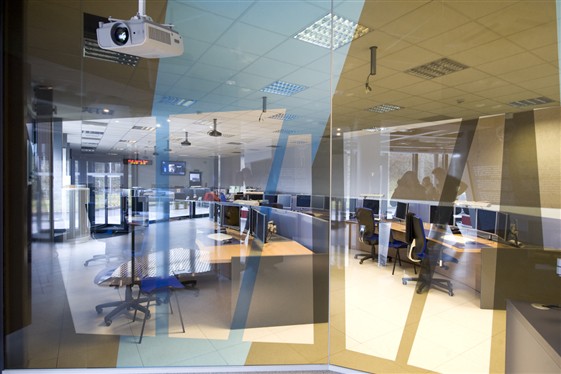
As I mentioned before, Tuesday is the big day when the LHC is going to produce, with the media to bear witness, its first 7 TeV collisions.  The preparations and build up to Media Day were already underway last week.  Twice we had video crews in the control room interviewing us at our stations.  I had the opportunity to speak with some filmmakers producing a documentary for a british funding agency and was requested to say an enthusiastic "ready!" to another team.  Besides the cameras in the control room there were many cameras in the Atlas Visitor's Center, which shares a smoked glass wall with the control room so that the visitors can see us scientists in our natural state.  When I first started taking shifts someone had taped a "don't feed the physicists" sign to the wall.  I now have great sympathy for zoo animals.  The visitors like to take pictures so you quickly learn to ignore their flashes and peering faces.

The view of the control room from the Visitor's center (via CERN)

As for as my part in the Media Day preparation, I am working on setting up a system so that members of the collaboration can quickly see plots as soon as the collisions happen.  Unfortunately I cannot share them here because we have rules about what we can show the public (almost nothing) but as soon as some pictures get made public I'll post them here!  

You can follow Tuesday's events from the CERN website, or even see a webcam of the Atlas Control Room if you register your ip address in advance.