Tuesday, March 30, 2010

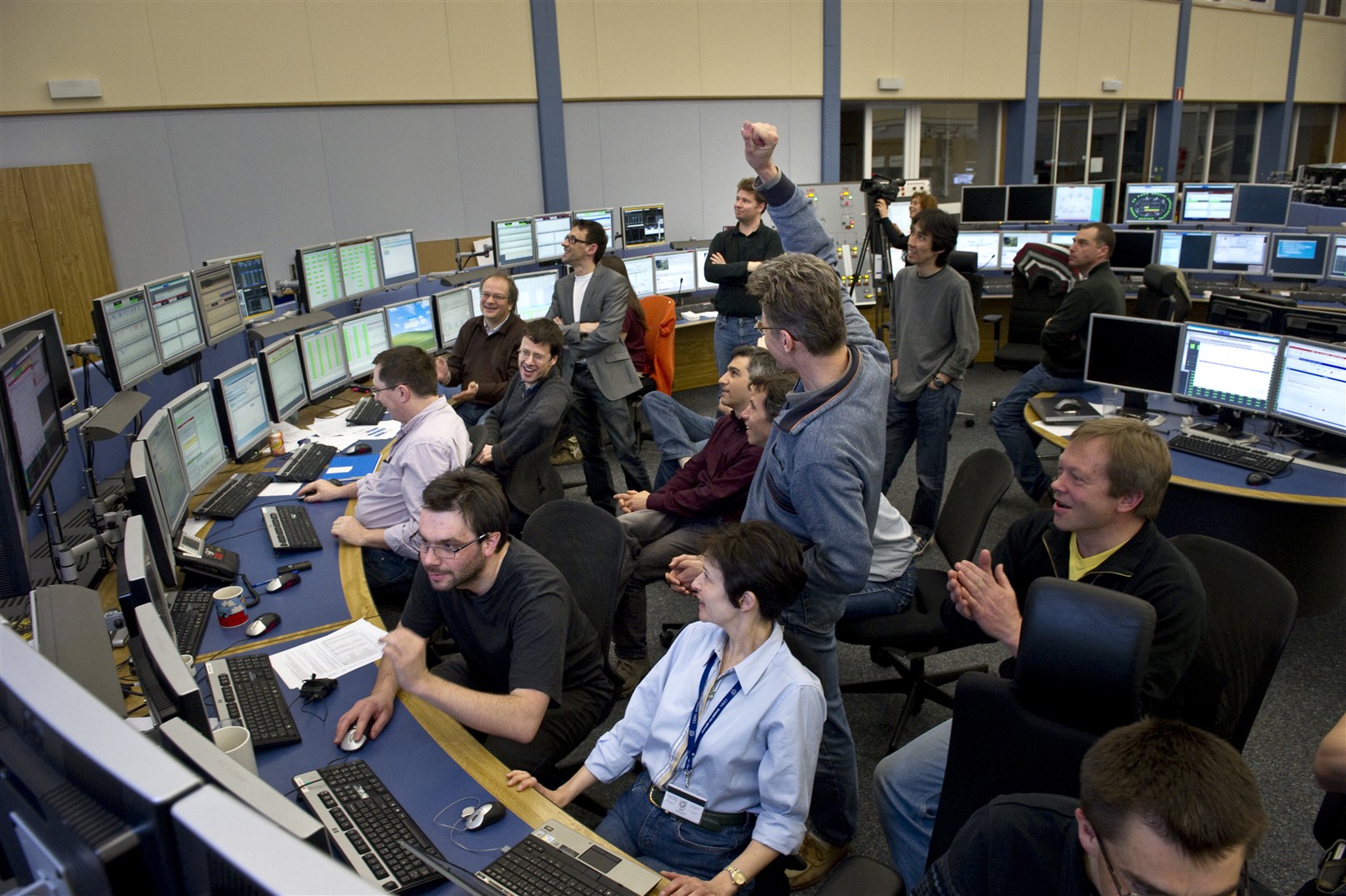
COLLISIONS!!!!


I've slept less than one hour in the past 31 but it was totally worth it.

Monday, March 29, 2010

Webcast

Its very likely that I will not sleep tonight for more than a few hours, if at all.  If you want to watch the webcast, here is a link.  Collisions are expected as early as 7am CERN time (PST+9, EST+6).

Sunday, March 28, 2010

Shift Summary and Outlook on the Upcoming Collisions

On Thursday I took my final shift for this block and, after three weeks of training and shifting, I was quite happy to not see the control room at 6:45am Friday morning.  Appropriately, the last hour of my last shift was the most exciting, complete with a bevy of experts swearing at the detector.  We lost control of two of the read out elements of the pixel detector and wresting them back into a state where we could communicate with them was a challenge.  I, having no idea what was going on, took orders and clicked where I was told to click and typed what I was told to type.  In the end all was fine (there was never any danger to the pixels or to ATLAS) and everyone, the experts included, learned something.

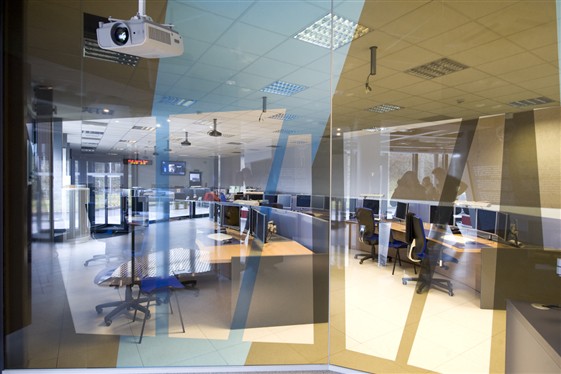
As I mentioned before, Tuesday is the big day when the LHC is going to produce, with the media to bear witness, its first 7 TeV collisions.  The preparations and build up to Media Day were already underway last week.  Twice we had video crews in the control room interviewing us at our stations.  I had the opportunity to speak with some filmmakers producing a documentary for a british funding agency and was requested to say an enthusiastic "ready!" to another team.  Besides the cameras in the control room there were many cameras in the Atlas Visitor's Center, which shares a smoked glass wall with the control room so that the visitors can see us scientists in our natural state.  When I first started taking shifts someone had taped a "don't feed the physicists" sign to the wall.  I now have great sympathy for zoo animals.  The visitors like to take pictures so you quickly learn to ignore their flashes and peering faces.

The view of the control room from the Visitor's center (via CERN)

As for as my part in the Media Day preparation, I am working on setting up a system so that members of the collaboration can quickly see plots as soon as the collisions happen.  Unfortunately I cannot share them here because we have rules about what we can show the public (almost nothing) but as soon as some pictures get made public I'll post them here!  

You can follow Tuesday's events from the CERN website, or even see a webcam of the Atlas Control Room if you register your ip address in advance.  

Thursday, March 25, 2010

Me, a lobbyist? Not really. (Part 2)

In my previous post on my DC advocacy trip I forgot to mention one important step in the preparation.  Being a lowly grad student who's wardrobe consists entirely of birthday and christmas presents, I had nothing professional to wear, prompting me to go on an epic hunt for formal business attire.  I stalked the suit racks in the wilds of Walnut Creek, raided the shoe stores of San Leandro and made repeated forays into San Francisco for dress shirts.  Bewildered and overwhelmed, I bought several outfits and after taking pictures and sending them out to friends with pleas for advice, I settled on a nicely tailored Calvin Klein skirt suit and a pair of sensible black pumps.
    
Mama's little girl is all grown up and asking people for money!

I flew in to DC early on the first day and met one of my wonderful and amazing friends, Clare, for lunch near the White House.  Clare is busy saving the world from climate change through her position as the Special Assistant to the Special Envoy for Climate Change (really, the title is not a joke!) in the State department.  Hillary Clinton is her boss's boss, how cool is that!?!  The rest of the day was taken up by last minute studying of my primary assignments and a dinner with all the trip participants. 

It was not the most beautiful day, but the White House was still impressive.

The next morning we had a meeting at the Universities Research Association's DC office to assemble the packets of information we were going to give to our offices and to do last minute coaching on "the message".  Then we were set loose on the capitol!  I went to approximately 10 offices over two and a half days including the three I was assigned to as a primary: Braley, Giffords and Pelosi.  I went along to the other seven to keep the conversation flowing and provide moral support for the person who had the primary assignment.

The office I enjoyed the most was Bruce Braley's, in part because my cousin Caitlin, his communication's director, made sure his legislative staff took care of me and took me to meet the congressman himself, which is rare.  The vibrant office was overflowing with people talking to each other in every available space.  Caitlin pulled us into the congressman's room to meet him.  He was very friendly, genuine and enthusiastic.  He was particularly concerned with physics education and how to get people interested in the subject, particularly in the rural areas of his district where the high schools may not be able to offer physics every year due to lack of demand.  He was interested to find out about ways that the excitement of research could be brought into the class room through communications technology.  I left with a very favorable impression and was happy to read this account of the health care wrangling which credited him with giving teeth to the reform.  The rest of his staff was excellent and asked that we keep them informed of any way they can help us, which is especially nice considering that there is no high energy physics being done in their district.

Perhaps the most interesting visit was with the staff member in charge of science policy for Texas Senator Kay Bailey Hutchison.  Senator Hutchison was engaged in a vicious primary battle for the republican governor candidate in Texas.  It had devolved into a how-wacko-conservative-can-you-get fight and Hutchison was getting pummeled.  She is a strong supporter of science and the ranking republican on the senate committee for science funding and hence a very important person.  Her staffer really just wanted to vent for 45 minutes about how frustrated he was for his boss, both with the democrats for health care and with the conservative elements in his party for being wackos.  He obviously believed in her and was sad to see her get so demoralized, particularly because many of the hits she was taking were for earmarks, which she always viewed as the way she protects and takes care of Texas.  We briefly got around to discussing science, in which we learned that he was from Downer's Grove, a town near where I grew up, and that he had attended the Fermilab Saturday Morning physics as a high schooler, something that I participated in as well.  The physics didn't take with him, however, he ended up an economist.  At the end of the meeting he told us that if there was anything we saw in the budget once it got to their committee that we didn't like, to let him know because "they could take care of it".  
The group getting ready to take a photo on the capitol steps.

The Hutchison visit was in the Senate buildings which were much nicer than the House equivalent.  With granite and gilt in abundance, the place felt spacious and calm, or stagnant, depending on your opinion of the Senate.   The House offices, by contrast, were like a network of beehives.  With the exception of a few offices and corridors, the place hummed, nowhere more so than the underground cafeteria where we ate lunch most days.  The petitioners in town to visit their Representatives, along with the staff and quite a few military officers congregated in the crowded space while on break, lunch or in between visits.  Whenever I had time to kill between meetings I could find someone else from our trip waiting around.  

The last noteworthy visit was, of course, with Nancy Pelosi's office, which was in the capitol building itself.  My secondary and I walked through the security on the side door and requested our visitor's badges.  We then got directions on how to reach the Speaker's office and got lost within two minutes.  We got lost three more times before finding the elusive office, including going down one hall that we were quickly ushered out of by a man who looked like he was plainclothes security.  Finding the office was so tricky because the building is full of narrow corridors and hallways that appear to lead to nowhere.  When we finally found the non descript entrance to the Speaker's quarters we walked through a small doorway into a hall with large ceilings, many doors and a young man sitting behind a desk in the middle of the hall.  It felt a bit like Alice in Wonderland.


Another view of the capitol building.  No foaming-at-the-mouth crazy racists protesters that day.

The young man directed us into a narrow elevator and which took us to what must be the attic, judging by its decidedly not grandiose decor and short ceilings.  After waiting a while, the harried science policy staffer took us to a conference room to hear us out.  Well, sort of hear us out.  He explained at the beginning that Senator Bunning's obstructionism had turned the day upside down for various reasons and so to not be bothered if he checked his blackberry while we were talking.  I think he spend 50% of the time listening and 50% of the time blackberry-ing.  Nancy Pelosi is very strong on science and we did not need to convince him of the value of basic research.  So he uncritically nodded in agreement with everything we said and I spoke fast to get in all in before the end of what we knew would be a short meeting.  He did ask interested questions about the baguette LHC incident, which, incidentally, I heard was actually not due to an errant baguette dropping bird.  After fifteen or twenty minutes were were back down the elevator, past the young man at the desk and on our way out of the building.

A mock-up of Hubble and an afternoon snack.

Other highlights of the trip included visiting the American Indian Museum and the Air and Space museum, visiting the high security DOE offices outside of DC to report on our visits, having drinks with my cousin and spending more time with Clare.  All in all it was a good trip but I am holding my breath until the budget gets passed, which, given the pace of Washington these days, might take a long time.  It was enlightening to see the way the government works, and I am now sure more than ever I do not want a career related to politics. 

Wednesday, March 24, 2010

Me, a lobbyist? Not really. (Part 1)


Our nation's capitol on a brisk February evening

Washington has been in the news quite often these days.  First it was Snowmagedeon bringing the federal government to a halt, then it was Senator Bunning holding up unemployment benefits because he was jealous of all the attention lavished on the weather, and finally, finally, the House and Senate passed Health Care Reform (Whooohooo!!).  With all of that going on you may not have heard of my trip to DC as a representative of High Energy Physics (HEP), which was not quite as newsworthy as a retiring Senator's grand standing.

Last fall, through a poster session aimed at outreach, I won an all expenses paid trip to DC as a part of the USLHC Users Organization (USLUO, an organization representing the interests of US institutions involved with the LHC) annual advocacy visit to the capitol.  Once a year USLUO teams up with the user's organizations of SLAC and Fermilab to remind congress people why high energy physics is worth funding.  While our budget is dwarfed by spending on, say, defense, our annual appropriations of hundreds of millions of dollars requires justification.

I think I was subconsciously aiming for 5th grade girls.
Here is a full resolution pdf of the poster.

Justification was necessary more than ever this year because the President's budget had come out quite favorably for HEP.  Normally you would think that a strong HEP budget request from the President  would make convincing appropriators easier, and in a normal budget year it probably does.  But this year is not a normal budget year.  The President, bowing to deficit hawks, also included a cap on total discressionary domestic spending.  The physical sciences (HEP included) was one of the few areas which received funding increases and consequently became a big fat target because an increase for us meant a decrease for others.

The mood on the Hill, as they say, was very positive towards science.  In fact, it is one of the few surviving bipartisan sentiments.   Everyone understands that we need investment in science and technology to keep our economy strong, and a 2007 report warning of our decline in technological capabilities, Rising Above the Gathering Storm, was on people's minds.  The America COMPETES Act, a response to the report which sets a path to doubling the physical science budget by 2017, was up for reauthorization as well so we were urging congresspeople to support it.  Simply stated, our mission was to get across the message:  "Thanks for supporting us last year, please support us at the President's request level this year and please vote for the reauthorization of COMPETES!"

The visit spanned three days and mostly consisted of meetings with legislative staff in Congresspeople's offices.  A couple of months before the trip we were asked to list, in a very specific format, our connections to different legislative districts.  Personal connections, such as knowing someone in the Congressperson's office, were valued most highly, followed by being a constituent, being a former constituent, having family members as constituents, etc.  The lists were sent to a Fermilab organizer-physicist, who ran a perl script to divide up the congress people among the representatives of our three organizations (hence the specific format--imagine if it was written in python).  We were responsible for getting an appointment with our assigned offices and for being knowledgeable about the districts.  Being a newbie to the trip and having connections to the Chicago area and the Bay Area, the two areas where most of the trip participants live, I had only 3 primary assignments: Bruce Braley of Iowa, Gabrielle Giffords of Arizona and our kick-*** Speaker, Nancy Pelosi.  My connections to the first two came through a cousin in the Braley office and a friend and former Berkeley grad student in the Giffords office.  The Pelosi connection derived from a member of my group at LBL who had met her before to talk about science (tenuous but no one else going on the trip had a better connection).

Preparations for the trip included weekly meetings with the SLAC group to go over relevant legislation and other details about the trip, a half day long meeting at FermiLab with perspectives from the SLAC and Fermilab directors and science lobbyists on the mood in Washington, and finally, business cards.  Yes, business cards.  Everyone in DC uses them.  At the beginning of every meeting we'd trade cards, my kinko's pseduo-cards for their official Senate or House ones.  I got a template from one of the other trip participants, printed them on cardstock at Kinko's, and cajoled Kyle into cutting them for me.

They didn't look too bad....but USLUO needs a new logo.

Cards in hand I was ready to fly out to DC.... Stay tuned for part 2, in which I describe my three days on the Hill playing dress-up/grown-up.


Saturday, March 20, 2010

Milestones

In case you haven't heard, early on Friday morning the LHC reached an energy of 3.5 TeV per beam,   its target energy for 2010-2011.  They did not collide the beams, in fact they lost them five minutes after reaching the historic energy, however they achieved a big milestone in reaching that energy.  The first official collisions at 7 TeV are due March 30th, when CERN hosts another "media day" where they invite the press to witness the event.  I'm sure the beam operators agree with us experimentalists that its pretty ridiculous to specify a day for first collisions.  It's like prescheduling a press conference for the birth of a child.  Sure there is a due date, but when the big event will actually occur is hard to predict.  Unlike labor, however, the first collisions can be held up by the "powers that be" if they look like they are going to be ready ahead of time.

LHC operators on Friday morning.
 I got this from a cool CERN page of pictures about the 7 TeV beams.


  While I was not in the control room for the 7 TeV beams, I was around for a crucial precursor test on Thursday night.  The LHC installed a new quench protection system (QPS) in the wake of the 2008 accident, to prevent the disaster that gave us this year long delay from happening again.  A quench, as I've mentioned before, is when a superconducting magnet, which has no resistance in its superconducting state, develops a resistance and suddenly losses its superconductivity.  I'm not sure if it's the new part of the system, or the existing part, but the QPS is now too sensitive.  When the LHC is turning up the currents in the magnets to bring them to the needed strength for a 7 TeV beam, the little fluctuations in the current values are enough to set the QPS system off.  This is problematic because what the QPS actually does is induce a controlled quench, distributing the energy more evenly along the magnet system.  In the tests performed early this week many magnets were quenching due to the QPS which is dangerous for the machine because the released energy heats up the superfluid helium and the LHC cooling system can't handle many magnets quenching at once.  As a temporary solution the beam operators decided to ramp up the current 5x more slowly than they normally do.  They were testing this fix by ramping the current in the magnets without beams durning my Thursday shift.  If it worked then we could ignore the QPS problems and procede with the 7 TeV beams, if it didn't the LHC would have to order new hardware to fix the problem which would've meant another 1-2 month delay.  We all held our breath and watched the LHC current inch upward on the monitoring plots during the 75 min ramp.  It was quite exciting when they reached the necessary current, even though there were not any beams!

The other milestone which makes this post title plural, is that I am now a fully qualified pixel shifter.  This isn't a big deal, all it means is that I get to sit at the Pixel desk all by myself and do what the experts tell me to do.  But still, it is kinda neat because I've had very little contact with the actual detector since I joined the Berkeley ATLAS group.  When I was at Orsay I worked on pieces of the Liquid Argon calorimeter, but since then I have been exclusively working on software.  It is fun to sit in front of four monitors and run calibration scans or monitor the detector status.  I'm sure the novelty will wear off soon, most likely next week during one of my four morning shifts, but for now it is amusing.   

Wednesday, March 17, 2010

Party in the PHYSICS LAB

Now for a bit of levity: LA = CERN, Nashville = LBL, Party = Meeting


Miley Cyrus - Party In The USA - (Official Music Video) [HD]
envoyé par VeronicaMars157. - Clip, interview et concert.

Inspired by this amusing post in ThinkProgress.