
Wednesday, April 7, 2010

Tuesday, April 6, 2010
A Week Later
It has been a week since the first collisions and I'm happy to say that ATLAS has recorded over 10 million events! That's more than enough for me to use for my thesis so I am one very happy grad student. Now I just have to the analysis....
Today I gave a talk to the entire collaboration about the performance of the Inner Detector, Tracking and B-tagging groups (don't worry about what that means). It was one of four talks given by 'young physicists' on the first 7 TeV results, roughly divided by subdetector and their related physics objects. I was presenting the work of a very large group of people and I was quite nervous that I would accidentally misrepresent someone's work or worse. As you might imagine it is hard to make that many people happy when you are presenting the results that they've worked very hard on! At some point this morning I realized that most of the people in my 3,000 strong collaboration don't know who I am, so in giving this talk I'm introducing myself to a significant subset of the people in my field....ack! Obviously only a small fraction of the 3,000 people were watching the talk and an even smaller fraction were in the room (it was webcast so people could watch it from the confort of their own institution or desk) but I still felt the pressure. In the end, despite me rushing through unrehearsed slides, the talk went over well. Luckily all the data and results looked so beautiful that the audience couldn't help but be happy!
I thought I'd share a few interesting recent articles:
Many of us grumbled at the trumped up Media Day the CERN management had scheduled for first collisions. We thought it was a bad idea because there was no guarantee that we would actually get collisions on that day and the LHC did not seem ready. Here is an alternative opinion on the subject and I must admit that the author has a point.
Last week the American Association of University Women published a report on the lack of women in science and engineering. The New York Times also reported on it. I haven't had the chance to read it, but it looks interesting.
Today I gave a talk to the entire collaboration about the performance of the Inner Detector, Tracking and B-tagging groups (don't worry about what that means). It was one of four talks given by 'young physicists' on the first 7 TeV results, roughly divided by subdetector and their related physics objects. I was presenting the work of a very large group of people and I was quite nervous that I would accidentally misrepresent someone's work or worse. As you might imagine it is hard to make that many people happy when you are presenting the results that they've worked very hard on! At some point this morning I realized that most of the people in my 3,000 strong collaboration don't know who I am, so in giving this talk I'm introducing myself to a significant subset of the people in my field....ack! Obviously only a small fraction of the 3,000 people were watching the talk and an even smaller fraction were in the room (it was webcast so people could watch it from the confort of their own institution or desk) but I still felt the pressure. In the end, despite me rushing through unrehearsed slides, the talk went over well. Luckily all the data and results looked so beautiful that the audience couldn't help but be happy!
I thought I'd share a few interesting recent articles:
Many of us grumbled at the trumped up Media Day the CERN management had scheduled for first collisions. We thought it was a bad idea because there was no guarantee that we would actually get collisions on that day and the LHC did not seem ready. Here is an alternative opinion on the subject and I must admit that the author has a point.
Last week the American Association of University Women published a report on the lack of women in science and engineering. The New York Times also reported on it. I haven't had the chance to read it, but it looks interesting.
Lastly, the BBC has a great LHC page full of information devoted to the project: http://www.bbc.co.uk/radio4/bigbang/
Thursday, April 1, 2010
The Big Day
Tuesday was big. It was huge. It marked the beginning of what will hopefully be an era of paradigm shifting discoveries, of a new understanding of our physical world and of post graduate life for yours truly. I'm going to try to capture a bit of the excitement of the day in this post. I don't think I've ever had a busier and more exciting two days in my life!

For me the madness of first collisions started on Monday morning because of this plot by CMS.

I have no idea how this CMS person was able to post this on the USLHC blog.
We would NEVER be able to do that in Atlas.
It is a plot of the position of the interaction points of protons in the LHC beams colliding with particles of gas in the beampipe. The LHC beam pipe is under a good but imperfect vacuum, so every now and then one of the protons collides a stray molecule. We refer to these events as beam gas events. They are normally a nuisance, however on Monday the LHC wanted to make sure that the positioning of the two beams was good enough so that they would actually hit each other when they attempt collisions. One method of doing this is to look at the position of these beam gas events and make sure they are coming from the same place for both beams.

CMS said they could measure the position of each beam with beam gas events to pretty good accuracy and presented the plots above as evidence. A few weeks ago the ATLAS experts took a look at doing this and determined that it was hard and would require a fair amount of dedicated work to be possible. However, Monday morning ATLAS management said that we needed to give the plot to the LHC as soon as possible. Most of the experts were away at conferences or otherwise unavailable so I was asked to help Juerg, an LBL staff scientist in charge of the beam spot group, find these beam gas events. At noon we holed up in an office and gave it a shot.
What makes finding beam gas events difficult is the fact that you have to separate them from beam halo events.

Beam Halo is caused by the beam interacting with gas or other material upstream of ATLAS. It produces a lot of junk in the detector and is not correlated with the position of the beam. The challenge is to separate these events from the beam gas events. To make a long story short we worked all night on this. Juerg went back to where he was staying and slept for a couple of hours, but I, having youth on my side, pulled the all nigher I never had in college and eventually found a way to separate these events in a run we were testing. It was a small moment of triumph where I felt that I had made a significant contribution to the experiment. Then we tried the method on the current data and found that it didn't really work because the events were much less contaminated by beam halo than the test sample and so the discriminator that I had found didn't discriminate anymore. Still, in the end we were able to give the LHC a beam position that was not as precise as CMS's but precise enough to say that "we could not rule out that the LHC beams would collide".
We came to this conclusion at 6am, just in time to prepare for the collisions! The LHC then tried twice to inject the two beams and bring them to full energy and failed. Since it takes several hours between attempts, I took the opportunity to sleep for an hour after the second failure.
When I came back from my restorative power nap and shower, I headed back up to the satellite control room where I had spent the nighttime hours I should've been sleeping. The satellite control room is a smaller, less impressive space two floors above the main control room where people look at the data after it comes off the detector.

The LHC takes almost an hour to go from injection energy to collision energy so it gave us ample time to bite our nails and stare at the monitors which showed it's progress. Once the monitors read "collapsing separation bumps", a sign that the were bringing the beams into collision position, the excitement and tension in the room was palpable.

When the collisions finally came we watched the monitors around us and saw event after gorgeous event flash by. It was amazing and thrilling and reminded me why I like physics so much. I was staring at collisions of protons that were turning their mass and energy into different particles and those particles were being observed by our detectors! I was looking at the data that would go into my thesis! The words that kept coming to my lips were gorgeous and beautiful and aesthetic appeal to the events was almost overwhelming. Not long after we saw the first events the leader of the scanning team started yelling out event numbers and the room turned to chaos. Luckily for me, the data I needed to run my processing scripts had a half an hour delay between when the events were taken and when they were made available to me. I took that opportunity to go down to the main control room and watch the festivities. It was packed and ebullient and the champagne was flowing. I got there too late to partake in the bubbly drinking, but several people had the foresight to bring extra bottles for the satellite control room so we got ours a bit later.
I spent the rest of the day marveling as the events kept on coming and continuing to update my plots for the collaboration. In a few hours we took as much data as we had in all of last year's lower energy runs. Eventually, around 6pm the LHC lost the beam and we left. I attended a meeting, ate dinner with my group, drank some celebratory wine and slept for a glorious 11 hrs.

An example of a beam gas event from CMS.
CMS said they could measure the position of each beam with beam gas events to pretty good accuracy and presented the plots above as evidence. A few weeks ago the ATLAS experts took a look at doing this and determined that it was hard and would require a fair amount of dedicated work to be possible. However, Monday morning ATLAS management said that we needed to give the plot to the LHC as soon as possible. Most of the experts were away at conferences or otherwise unavailable so I was asked to help Juerg, an LBL staff scientist in charge of the beam spot group, find these beam gas events. At noon we holed up in an office and gave it a shot.
What makes finding beam gas events difficult is the fact that you have to separate them from beam halo events.

Beam Halo crap in ATLAS.
We came to this conclusion at 6am, just in time to prepare for the collisions! The LHC then tried twice to inject the two beams and bring them to full energy and failed. Since it takes several hours between attempts, I took the opportunity to sleep for an hour after the second failure.
When I came back from my restorative power nap and shower, I headed back up to the satellite control room where I had spent the nighttime hours I should've been sleeping. The satellite control room is a smaller, less impressive space two floors above the main control room where people look at the data after it comes off the detector.

The satellite control room on Tuesday Morning.
I was there as an extension to the event scanning team, a group of people whose job it was to find the prettiest events and make them public as soon as possible. All the event pictures I've shown in the previous posts were made in this room. I was not working on the event displays but on a webpage which took the data and made general plots available to the collaboration soon after the run started so people could get a feel for the events.
The LHC takes almost an hour to go from injection energy to collision energy so it gave us ample time to bite our nails and stare at the monitors which showed it's progress. Once the monitors read "collapsing separation bumps", a sign that the were bringing the beams into collision position, the excitement and tension in the room was palpable.

When the collisions finally came we watched the monitors around us and saw event after gorgeous event flash by. It was amazing and thrilling and reminded me why I like physics so much. I was staring at collisions of protons that were turning their mass and energy into different particles and those particles were being observed by our detectors! I was looking at the data that would go into my thesis! The words that kept coming to my lips were gorgeous and beautiful and aesthetic appeal to the events was almost overwhelming. Not long after we saw the first events the leader of the scanning team started yelling out event numbers and the room turned to chaos. Luckily for me, the data I needed to run my processing scripts had a half an hour delay between when the events were taken and when they were made available to me. I took that opportunity to go down to the main control room and watch the festivities. It was packed and ebullient and the champagne was flowing. I got there too late to partake in the bubbly drinking, but several people had the foresight to bring extra bottles for the satellite control room so we got ours a bit later.
I spent the rest of the day marveling as the events kept on coming and continuing to update my plots for the collaboration. In a few hours we took as much data as we had in all of last year's lower energy runs. Eventually, around 6pm the LHC lost the beam and we left. I attended a meeting, ate dinner with my group, drank some celebratory wine and slept for a glorious 11 hrs.
Tuesday, March 30, 2010


Monday, March 29, 2010
Webcast
Its very likely that I will not sleep tonight for more than a few hours, if at all. If you want to watch the webcast, here is a link. Collisions are expected as early as 7am CERN time (PST+9, EST+6).
Sunday, March 28, 2010
Shift Summary and Outlook on the Upcoming Collisions
On Thursday I took my final shift for this block and, after three weeks of training and shifting, I was quite happy to not see the control room at 6:45am Friday morning. Appropriately, the last hour of my last shift was the most exciting, complete with a bevy of experts swearing at the detector. We lost control of two of the read out elements of the pixel detector and wresting them back into a state where we could communicate with them was a challenge. I, having no idea what was going on, took orders and clicked where I was told to click and typed what I was told to type. In the end all was fine (there was never any danger to the pixels or to ATLAS) and everyone, the experts included, learned something.
As I mentioned before, Tuesday is the big day when the LHC is going to produce, with the media to bear witness, its first 7 TeV collisions. The preparations and build up to Media Day were already underway last week. Twice we had video crews in the control room interviewing us at our stations. I had the opportunity to speak with some filmmakers producing a documentary for a british funding agency and was requested to say an enthusiastic "ready!" to another team. Besides the cameras in the control room there were many cameras in the Atlas Visitor's Center, which shares a smoked glass wall with the control room so that the visitors can see us scientists in our natural state. When I first started taking shifts someone had taped a "don't feed the physicists" sign to the wall. I now have great sympathy for zoo animals. The visitors like to take pictures so you quickly learn to ignore their flashes and peering faces.

As I mentioned before, Tuesday is the big day when the LHC is going to produce, with the media to bear witness, its first 7 TeV collisions. The preparations and build up to Media Day were already underway last week. Twice we had video crews in the control room interviewing us at our stations. I had the opportunity to speak with some filmmakers producing a documentary for a british funding agency and was requested to say an enthusiastic "ready!" to another team. Besides the cameras in the control room there were many cameras in the Atlas Visitor's Center, which shares a smoked glass wall with the control room so that the visitors can see us scientists in our natural state. When I first started taking shifts someone had taped a "don't feed the physicists" sign to the wall. I now have great sympathy for zoo animals. The visitors like to take pictures so you quickly learn to ignore their flashes and peering faces.
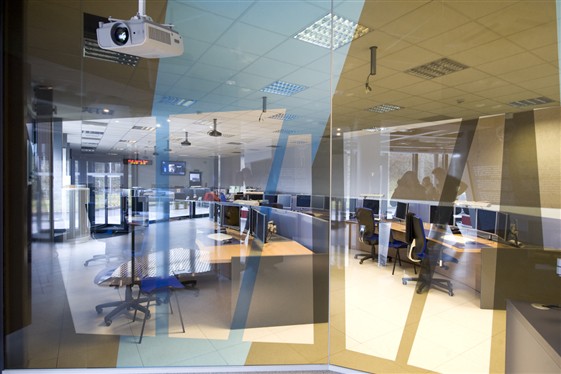
The view of the control room from the Visitor's center (via CERN)
As for as my part in the Media Day preparation, I am working on setting up a system so that members of the collaboration can quickly see plots as soon as the collisions happen. Unfortunately I cannot share them here because we have rules about what we can show the public (almost nothing) but as soon as some pictures get made public I'll post them here!
You can follow Tuesday's events from the CERN website, or even see a webcam of the Atlas Control Room if you register your ip address in advance.
Subscribe to:
Posts (Atom)